Showing posts with label Buddhism in the West. Show all posts

Tuesday, August 17, 2010

The Challenge of Bringing Theravada to the West

by Bhikkhu Bodhi

(an extract from keynote address at a seminar on “The Necessity for Promoting Buddhism in Europe,” held on the first death anniversary of Ven. Mitirigala Dhammanisanthi Thera. Colombo, 2 July 2000)


... When I ponder this issue, the question that immediately lodges itself in my mind is this: 

“What exactly is the type of 
Theravada Buddhism 
that we wish to spread?” 

For one thing, it is not merely texts and ideas that Westerners are looking for, not merely the Buddhism of the books. Books are certainly needed to introduce people to the Dhamma, to give them material for study and reflection. The point I wish to make is not that literature on Buddhism is dispensable, but that it is insufficient. For the Dhamma to take deep root in people’s hearts, it must come to them, not between the covers of a book, but in living, breathing persons who display the truth of the teaching in their lives.

Thus when I raise the question, 

“What type of Buddhism 
do we wish to spread?” 

I am not thinking of the pure canonical Dhamma, which exists as such only in the books. In actuality, Buddhism has always been expressed in concrete practices, embedded in social structures, and embodied by real human beings. Thus we have to consider this aspect of Theravada Buddhism and not merely the doctrinal formulas of the Pali Canon. So when we ponder how to bring Buddhism to the West, we have to decide which of the many faces of Theravada we want to bring. To some extent, this is premature, since if Buddhism does eventually take root in the West, it will assume forms particular to Western social and cultural conditions. But to begin we need something to serve as a seed or nucleus.

The ideal form of Theravada to present would be one that fuses all healthy aspects of the tradition into an organic whole. The transmission would have to focus on the practice of meditation, yet it should include a strong emphasis on Buddhist ethics (including Buddhist perspectives on contemporary ethical issues), textual and doctrinal study, devotional practices, and a fair share of ritual, too; but ritual would have to be integrated into the spiritual path, not pursued in compliance with mere cultural norms. 


The meditation practice should be 
the heart of the transmission. 

Once students experience the beneficial effects of meditation on their lives, in time they will develop keener interest in the study of texts, in devotional practices, in the precepts, and in ritual. Ritual will then serve to cement these varied aspects of Dhamma into a coherent whole, animated from within by the meditative experience.

Sunday, August 15, 2010

BUDDHISM RISES IN THE WEST

by Piya Tan

 ALEXANDER THE GREAT
(Source: Roman mosaic found in the House of the Faun, Pompeii, Italy.)


Buddhism began to become effectively global with Alexander the Great’s invasion of northwest India (4th century BCE). This cultural cross-current gave us a remarkable work on Buddhist apologetics, entitled the Milindapañha (The Questions of Milinda, see book below). Milinda was Menander 1 Soter (reigned 155-130 BCE), a Buddhist ruler of the Indo-Greek Bactrian kingdom in present day Pakistan. With Greek influence, too, we see perhaps the most beautiful of Buddha images, modelled after the sun-god, Apollo, complete with wavy hair, flowing pleated robes and halo.


Coins show the second-century BCE Indo-Greek 
KING MILINDA (MENANDER) of Taxila
155 BCE - 130 BCE


Inscribed Portrait of KING ASOKA 
from Kanganhalli (Courtesy ASI)

Buddhism reached its height in the time of the Indian emperor Asoka (3rd century BCE), who it is said to have sent out various missions that brought Buddhism to south and southeast Asia (and Vietnam), Persia (modern Iran), the Middle East (including Israel), Egypt and the West, especially Asia Minor (or Anatolia, including modern Turkey), Greece, and Italy. With the rise of the Abrahamic religions, much of this is history now, although we still see vestiges of Buddhist stories in local folk tales, especially that of “Bar­laam and Josa­phat,” a Christianized version of the Buddha story. [1]

Apparently, the relics of the Buddha made their way to the West. Few mediaeval Christian names are better known than those of Barlaam and Josaphat, [2] who were credited with the “second conversion” of India to “Christianity,” after the country had relapsed to “paganism” following the mission of the Apostle Thomas. Barlaam and Josaphat were remembered in the roll of saints recognized by the Roman Catholic Church with the festival day of 27 November. In the Greek Church, Iosaph (Josaphat) was commemorated on 26 August, while the Russians remember both Barlaam and Ioasaph, together with the latter’s father, king Abenner (Suddhodana), on 19 November (2 December, Old Style). Sir Henry Yule once visited a church at Palermo, Italy, dedicated to “Divo Josaphat.” 

In 1571, the Doge Luigi Mocenigo presented to king Sebastian of Portugal a bone and part of the spine of St Josaphat. When Spain annexed Portugal in 1580, these sacred treasures were removed by Antonio, the pretender to the Portuguese throne, and ultimately found its way to Antwerp, Belgium, where they were preserved in the cloister of St Salvator.

After the European colonists had settled in India, with the arrival of Roman Catholic missionaries, some of them were struck by the similarities between episodes and features of the life of St Josaphat and those of the Buddha, as is clearly evident from the early 17th century Portuguese writer Diogo do Couto who declared this fact. By the 1850s, European scholars doing comparative study of the legend of St Josaphat (“Bodhisat”) and the life of the Buddha, 

“came to the startling conclusion that 
for almost a thousand years, 
the Buddha in the guise of the holy Josaphat, 
had been revered as a saint of 
the principal Churches of Christendom”! 
(DM Lang, introduction, Barlaam & Josaphat, 1967:x-ix)

With Western colonialism and European contact with the East, Buddhism again began flowing back to the West, beginning with scriptural scholarship, and now blossoming into numerous Western Buddhist groups and teachings. After about a century of Western scholarship in Buddhism, we now have ever more accurate editions and translations of the early Buddhist texts, complete with critical apparatus, in English and other European languages. 

Following the 1960 hippie counter culture movement that experimented in Oriental religions and altered states of consciousness, growing numbers of westerners, including many well-educated seekers, came to the East to become Theravada monastics, Zen priests and Vajrayana practitioners. The latter two traditions have been successfully westernised, although not without some major hiccups. [3] 

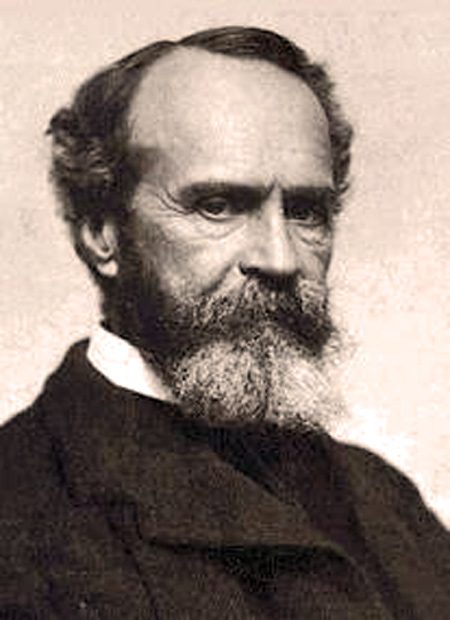
A new, and very important, development is the interest of Western science in Buddhist meditation, especially the mindfulness practices of early Buddhism. This interest in Buddhist psychology started over a century ago, with pioneers like William James, but it was only in the mid-20th century that the momentum began to pick up. Mind scientists can now see and measure, for example, what happens in the human brain during meditation.  So significant is this new meeting of science and religion, between western psychology and ancient Buddhism, that the scientists now even have their own annual retreats conducted by other scientists experienced in Buddhist meditation. [4]

In Varieties of Religious Experience (1902),
William James (1842-1910) also promoted
the functional value of meditation
for modern psychology. 
He wrote:

“This is the psychology 
everybody will be studying 
twenty-five years 
from now.”

When Buddhism left India and changed the societies that adopted it, Buddhism was in turn changed by these societies, so that what is originally the Buddha’s teachings and methods went through a sea-change or were altogether set aside. However, with the rise of Westerners and the western-educated turning to “forest” Buddhism today, seeking a more pristine practice in early Buddhist meditation, we now have a better chance of tasting the refreshing spiritual springwater at its source, as it were.
 
The 20th century British historian, 
Sir Arnold Toynbee (1889-1975)
was attributed with saying,

“The coming of Buddhism to the West 
may well prove to be 
the most important event of 
the Twentieth Century.”
 
 The truth of such words goes beyond who actually said them. Let’s say it is now becoming common wisdom of an uncommon phenomenon.

Revisioning Buddhism 24
[an occasional re-look at the Buddha’s Example and Teachings]
Copyright by Piya Tan © 2010


[1] See eg http://en.wikipedia.org/wiki/Barlaam and Josaphat

[2] See, for example, Graeme MacQueen’s “Changing Master Narratives in Midstream: Barlaam and Josaphat and the Growth of Religious Intolerance in the Buddhalegend’s Westward Journey.” Journal of Buddhist Ethics 5 1998:144-166.

[3] See Bad friendship = SD 34.1: http://dharmafarer.org/wordpress/?page_id=2583

[4] See Meditation and Consciousness = SD 17.8c: http://dharmafarer.org/wordpress/wp-content/uploads/2009/12/17.8c-Meditation-consciousness.-piya1.pdf


********* 

The Milinda Panha is, with good reason, a famous work of Buddhist literature, probably compiled in the first century B.C. It presents Buddhist doctrine in a very attractive and memorable form as a dialogue between a Bactrian Greek king, Milinda (Menander), who plays the 'Devil's Advocate' and a Buddhist sage, Nagasena. The topics covered include most of those questions commonly asked by Westerners such as:

“If there is no soul,
what is it that is reborn?”
and
“If there is no soul,
who is talking to you now?”

This abridgement provides a concise presentation of this masterpiece of Buddhist literature. The introduction outlines the historical background against which the dialogues took place, indicating the meeting of two great cultures that of ancient Greece and the Buddhism of the Indus Valley which was a legacy of the great Emperor Asoka. It is hoped that the adequate references, glossary, index and list of Pali quotations will provide readers with an incentive to read further from the translations of the Pali texts.

Visit our website: www.inwardpath.org for more books.